Thursday, October 4, 2018

Tips To Extend The Lifespan Of Your New AC System

Tips To Extend The Lifespan Of Your New AC System


While it might seem evident that AC systems require regular and routine maintenance like your vehicle, a lot of homeowners ignore it. Unfortunately, your AC unit is typically something that you under-appreciate until you don't have it anymore or until it stops working correctly. Once you lose the comfort that your AC unit provides, only then do you understand how important it is to the comfort of your entire home. Luckily, there are plenty of things that you can do to extend the lifespan of your new AC system.

Top Tips To Extend The Lifespan Of Your System:


1. Regular Maintenance.


HVAC tech is removing ac compressor & condensor coil to repair leaks in the systemOne of the most important things that you are going to want to invest in when it comes to keeping your AC system in its best possible shape is regular maintenance. Investing in regular and routine maintenance from a professional is absolutely the best thing that you can do to keep your AC unit functioning optimally. A professional will be able to look at your AC unit, figure out inefficiencies that might be inhibiting optimal performance, and more. Getting maintenance performed annually on your system is the easiest and most effective ways to extend the overall lifespan of your HVAC system by far. Along with providing preventative maintenance, they will also be able to thoroughly clean various parts of your AC unit including your coil and drain line to get everything performing as well as it should and as efficiently as possible.

2. Invest In Programmable Thermostats.


Another very effective way to extend the lifespan of your HVAC system is to invest in a smart and programmable thermostat. This alone is going to allow you to extend the lifespan of your unit because you won't be pushing your AC unit to the brink. You want to be reasonable when you are setting your temperature. Therefore, on an extremely hot day hitting 100 degree's, you don't want your system working to keep your house temperature at 65 degrees. Because it will be virtually impossible to achieve that kind of stable temperature all day, it is going to force the system to overwork itself. Instead, you want to set reasonable temperatures which will avoid overworking your AC unit all of the time.

The single best way to ensure that you are using reasonable temperatures is by investing in a smart and programmable thermostat which will allow you to effectively control the overall temperature in your home even when you aren't home. Along with this, you can invest in smart options that will shut off and turn back on as you leave and enter your home. This will not only keep your home entirely more comfortable, but it can help you achieve maximum efficiency with your unit which will not only save operational costs but also work your AC unit much less to allow it to function better for longer.

3. Care For Your System.


When dealing with your HVAC system and trying to eke out the best performance and lifespan of it, you want to care for both the indoor and outdoor components of your HVAC system. You should be doing everything to try to make your system work much more efficiently to avoid overworking your unit altogether. Some of the beneficial methods to do this are by regularly changing the air filter which maximizes the amount of air that is able to pass through the system. Along with this, it can make it less difficult to push the air through the system which can ease the stress the system has on it at all times. In fact, merely replacing an air filter can help lower the energy that your AC unit consumes by up to 10 percent.

There are many different things that you can do to make it so that your AC unit is able to function and perform optimally for years down the road. Keeping your AC unit working as well as it possibly can for as long as it can isn't too complicated. You only need to care for it and be diligent and proactive with your maintenance efforts.

Ideally, you want to hire a professional HVAC contractor like Icon Mechanical to perform the routine yearly maintenance on your unit. That way, you will be able to have a trained set of expert eyes on your unit to check for potential problems and problems that might not have even occurred yet. Along with this, they will be able to thoroughly clean your unit and all of the components that need to be cleaned to keep it functioning as efficiently as possible. Doing all of this should allow you to maximize the efficiency, performance, and lifespan of your entire AC unit.

Monday, September 24, 2018

Home AC Recharge: How Often Does It Need To Be Recharged In Phoenix AZ?

Home AC Recharge: How Often Does It Need To Be Recharged In Phoenix AZ?


Many homeowners wonder how often they should recharge their ACs in Phoenix, AZ. The simple answer is "Never" unless there is a leak in the system. That is where preventive maintenance becomes essential. In fact, proper and regular maintenance can increase the efficiency and lifespan of your system. Refrigerant leaks can be avoided when you implement an appropriate schedule of maintenance for your HVAC system. There is no better time to have your AC unit serviced in Phoenix than before the summertime arrives. The Arizona heat can tax your system to such an extent that it may end up needing expensive repairs unless you have a proper maintenance schedule for the unit.

What Is A Refrigerant?


A refrigerant is a compound in a fluid or gaseous state that helps the air conditioner system in its cooling process. In fact, a refrigerant will absorb heat from the environment and cools your space. Without a refrigerant, there cannot be freezing, air conditioning or refrigeration technology. The refrigerant will absorb heat from indoor air and transit into a high-pressure liquid from a low-pressure gas. The refrigerant is then sent outside where a fan is used to blow hot air over the coils of the unit. It is then exhausted to the exterior. The refrigerant cools down and transits into a low-pressure gas once again. Another fan will blow air over the cooling coils to distribute the cool air throughout the building. Your home or office is cooled due to the repetition of this cycle.

Freon is a brand name of a popular refrigerant on the market today. In fact, Freon and refrigerant are almost used interchangeably in the HVAC industry. That is due to the popularity of the substance. Freon is a Hydrochlorofluorocarbon (HCFCs) which is known as R-22.

Why Shouldn't R22 Be Used In Your HVAC System?


R22 is a Hydrochlorofluorocarbon that is commonly used in almost all the old HVAC systems in the country. R22 was found to be damaging to the ozone layer of the planet. Hence, the EPA implemented a phase-out as a result of the "Clean Air Act" of 2010. In fact, R22 is not used in the more recently manufactured HVAC systems. These systems use an alternative refrigerant known as R410A that is more eco-friendly than R22. R410A doesn't damage the ozone layer of the planet. On the other hand, R22 is going to be completely phased out by 2020. The price of a pound of R22 has drastically increased during the past couple of years due to the phasing out of the substance. Once the refrigerant is completely phased out in January 2020, it won't be available even for servicing the existing units. That is why you shouldn't use R22 in your AC system. In case you have an old system that uses R22, you should consider replacing the unit or the gas in the system before 2020.

r22-and-r410a-refrigerant-containers

Why Would Your AC Need A Recharge?


Preventive maintenance can reduce the chances of recharging your AC. In case the AC doesn't cool your home, there might be something wrong with the system. In fact, there could be many reasons for this. A refrigerant leak is one of the most common issues in case your AC system isn't cooling the house as expected. There are many things to consider where home AC recharge is concerned. The process involves refilling your AC with the appropriate refrigerant.

Important Signs That Your System Needs A Recharge


Your HVAC system is built not to lose refrigerant during its operation. The refrigerant should last during the entire lifetime of the system under normal circumstances. But there could be many instances where a refrigerant leak can occur. Proper maintenance will help avoid such situations and prolong the lifespan of your system.

If your vents are blowing out room-temperature air, it is considered an important sign that your system needs a recharge. On the other hand, the build-up of ice/frost on the unit is another vital sign in this regard. Refrigerant leaks are also caused due to the damage to the system.

Why You Need The Correct Amount Of Refrigerant For Your AC


Having too much refrigerant in your AC system is just as bad as not having enough. In fact, too much refrigerant in the AC will make it blow hot air similar to having too little refrigerant in the system. The system should have the correct amount of refrigerant to get the coldest air possible in your home or office.

The Process Of Fixing An AC Leak


Fixing a refrigerant leak in your AC is best left to a professional HVAC contractor in the area. It is not the best DIY project for anyone without extensive experience in the process. Make sure that you hire a reliable and experienced HVAC contractor in the area to fix a refrigerant leak in your AC.

Thursday, September 13, 2018

Indoor Air Quality And Your Health

Indoor Air Quality And Your Health


Indoor air quality is an important aspect to pay attention to. The overall indoor air quality of your home can play an integral role in you and your entire family's health. Because of this, it is essential to understand if it is harming you and anyone living within your household. Whether you are experiencing symptoms or not, you want to be aware of the overall quality of the air because symptoms will not always present themselves.

Below we discuss some potential symptoms to look out for when you are assessing your indoor air quality, possible respiratory health effects, how to diagnose air quality, what you might be able to do about fixing it, and the general AC maintenance that you should do to prevent it.

man with mask because of indoor air pollution

Potential Symptoms To Look For:


1. Allergies.


One of the sure ways to figure out if you are an air quality concern in your home is to figure out whether or not your allergies are being triggered (if applicable). If you are someone that suffers from allergies, it might be very tempting to just brush it off as a product of weather changes and seasonal allergies. However, it could be caused by a sensitive reaction to the indoor pollutants and containment that are dispersing into your air regularly by your AC unit.

No matter what you are sensitive to, indoor air pollutants can be at the direct root of your problem. A lot of people react and suffer from allergy symptoms when they are exposed to various things including irritants, pollen, or even dust.

2. More Severe Symptoms.


While you might experience various common allergy symptoms, you also want to be on the lookout for much more severe symptoms that might present themselves. Some of the more serious indoor air pollutants and contaminants like toxic mold growth, chemicals, and even asbestos can cause severe symptoms that might result in nausea, vomiting, fever, chills, and more. If you find yourself or anyone in your household experiencing these extreme symptoms, you will want to call a professional immediately to be able to accurately diagnose the problem that might be leading to extreme indoor air pollution.

Potential Respiratory Health Effects:


1. Short Term.


Over the short term, you might experience various symptoms related and virtually indistinguishable from a common cold or viral disease. Because of this, it makes it very difficult for successfully diagnosing air problems.

2. Long Term.


Various much more severe respiratory health problems can show up years after consistent exposure. In fact, symptoms leading to various respiratory diseases including asthma can occur in individuals that are exposed to bad indoor air quality over an extended period of time.

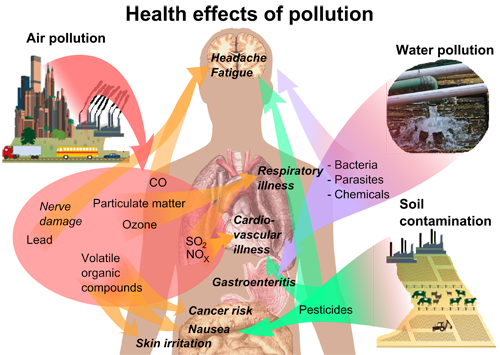
map of the body with Health effects of pollution

How To Identify Poor Air Quality?


1. Notice Symptoms.


The most significant indicator that you have an indoor air pollution problem is identifying and noticing symptoms as they occur. Symptoms of people living in the home is a crucial indicator, and it is likely the first thing that you will notice.

2. Identify Potential Sources.


An excellent way to figure out whether or not you have an indoor air quality problem is by identifying the different sources that could exist. By knowing what could cause the problem in the first place, you will be able to look out for any issues with it.

3. Musty Odors.


Another good way to tell if you have an air quality problem would be noticing any sort of musty odors stemming from your AC unit. If you notice a distinct and musty type of smell protruding from your AC unit, you are likely dealing with mold growth in your ventilation system. This type of mold growth is common. This is especially common if you do not regularly invest in routine yearly maintenance for your HVAC system. The best way to determine if you have a distinct odor emitting throughout your home is by removing yourself from your home and breathing fresh air and then placing yourself back in your home. You should be able to tell whether or not there is an odor present. If not, you can always use someone unfamiliar with the usual 'scent' in your home.

4. Walls.


Another indicator to determine if you have any sort of air quality problem would be to check out your walls. Sometimes, you might notice either excess moisture, condensation, or even mold growth on your walls. This will provide you with enough evidence needed to know that you might be dealing with poor air quality.

How To Avoid Poor Air Quality?


1. Keep Carpets and Floors Clean.


One of the biggest things that you are going to be able to do to keep your home free from airborne pollutants effectively is to keep your carpets and hardwood floors clean. You want to use a vacuum with a HEPA filter and potentially get your carpets cleaned by professionals.

2. Maintain Proper Humidity Levels.


Something you are going to want to do is to be sure to maintain proper humidity levels throughout the year. You want to maintain around 30 to 50% humidity to keep various allergens at bay. Dust mites and mold absolutely thrive in moisture-rich environments.

3. Routine HVAC Maintenance and Cleaning.


You want to invest in professional and routine HVAC maintenance and cleaning to keep everything functioning correctly and to keep your filters clean.

Overall, a lot that can be done to improve the quality of the air inside your home. If you follow the advice discussed in the article above, you should be able to do just that.  If you have any questions contact us.

Tuesday, September 4, 2018

How To Handle AC Smells Musty

How To Handle AC Smells Musty


Once you are finally at the point where you need to turn on your air conditioner for the first time in a while to kick off the summer, all you are likely hoping is that it works. This is where off-season maintenance comes into play. You need to carefully maintain your AC unit throughout the winter months to keep it ready for the warmer months when you will be using it a lot. Routine maintenance will not only help you keep your AC unit as clean as possible, but a professional can spot problem areas that might cause issues down the line.

However, AC maintenance is not only for keeping everything working correctly. It is also to keep your unit free from the musty smell that can build up if you are not paying attention to it. Below, we will be going over what makes your AC unit smell, whether or not it is dangerous, how to get rid of it, and how to prevent it from happening in the first place.

What Is The Smell?


If you just turned on your AC unit for the first time in a while and your unit is kicking out a musty odor, your unit is in need of a thorough cleaning job. Unfortunately, that musty smell is a signal/sign that mold has grown and built up rapidly in your unit which can cause your unit to output a musty odor. Mold is something that tends to grow in cool and dark areas. Because of this, your air conditioning unit is a very prominent place to experience mold growth. For this reason, it is imperative to keep your air conditioning unit clean at all times.

Adult Woman Holding Nose because of bad AC smellWhat Causes It?


Evaporator Coil


There are various things that can cause mold growth or an odor problem stemming from your AC unit. For one, it can be your evaporator coil. If it ends up being your evaporator coil, you are going to want to be sure that your AC coils are routinely cleaned throughout the year. While it might be tempting to handle it on your own, it is always recommended to hire a professional for jobs like this.

Air Ducts or Drain Line


Another problem that could be causing your mold growth or odor problem is leaks in your air ducts or even a clogging in your drain line. While these aren't necessarily the first places you might think to look if you are experiencing a musty odor, they are the likely causes of the problem. Either problem could result in an environment where mold can grow rapidly. If you are dealing with a leak in your air duct, it can be especially prominent to experience mold growth due to the damp and dark conditions.

Routine maintenance is going to be a great way to effectively avoid these issues from ever occurring in the first place. However, if you are dealing with something like a leak, it is going to need to be fixed to prevent the same problem from happening over and over again.

Is It Dangerous?


While it is not necessarily an immediate threat that can pose significant risks to you and your family's health, it is something that can cause long-term health complications if not treated promptly and adequately. Unfortunately, mold growth in your AC unit can become a huge problem primarily because it can then circulate throughout your entire home and become an airborne irritant that can cause issues with your respiratory system.

This is especially problematic for those that might have people living in their homes that suffer from various respiratory illnesses and disorders. A lot of people will experience allergic-type symptoms when dealing with prolonged exposure to mold. Mold exposure is never a good thing, and it can cause even more severe problems in those that deal with significant sensitivities to it. Therefore, it is best to be avoided at all costs especially with something that can be easily prevented.

Overall, there are a lot of things that you are going to want to be aware of when it comes to dealing with musty odors and mold growth stemming from your AC unit. Regardless of the problem, you want to get it solved by a professional as soon as possible. While not necessarily an immediate threat, long-term exposure to mold is never a good thing. By investing in routine maintenance for your AC unit during the warmer months, you should be able to easily prevent a lot of these problems from becoming a larger issue. You want to focus on hiring a professional to perform the routine maintenance because they know and understand what to look for and the signs and problems that could steamroll into mold growth in your AC unit.

If you have a bad smell in your house because of your AC unit, be sure to contact Icon Mechanical.

Monday, August 27, 2018

Is Annual Furnace Inspection in Phoenix Important?

Is Annual Furnace Inspection in Phoenix Important?


You have likely heard about the need for annual furnace inspections. Most furnace manufacturers will tell you that you should have your furnace inspected every year. It's printed in the manuals, and your contractors will mention it to you when they install it. Is it essential to book someone to come out every single year? The answer, as with so many other topics, is "it depends." In Phoenix, despite the usually warm to hot weather, it is a good idea to take good care of your furnace.

New Furnaces Are Quite Resilient


The way that the manufacturers word their recommendations makes it sound like if you don't have your furnace inspected every single year, then the warranty will be void. This is not necessarily the case. It's best practice to have your heater checked on a regular basis, but it isn't always necessary. In most parts of the country, you would probably get away with having a new furnace checked out every two years. When your heater is over ten years old, it starts making more sense to have it checked every year because there is more wear and tear and more potential points of failure.

Phoenix is a particular case, however, because the dusty desert air is more likely to clog filters and do damage to the unit. Since the unit is under more stress, it starts making sense to have it maintained on a regular basis. That's the other thing that you should consider - the difference between a simple inspection and a full annual maintenance check-up.
Furnace Inspection Tech doing repairs in Phoenix

What Do HVAC Technicians Do In an Inspection?


Inspections and maintenances checks can vary massively in what you get out of them. Some companies will do a quick inspection that will determine whether or not the unit is safe to use. If you're a landlord, then it makes sense to have one of those checkups performed on all of your properties quite regularly. They're inexpensive, and they can save lives.

If you are currently a homeowner and you want to make sure that your furnace is running well, then it's a good idea to have a more comprehensive check performed. Things that might be checked include:
  • Wiring: to make sure it is not corroded or damaged

  • Air intakes: these should not be blocked or obstructed

  • Blower access door: does it form a tight seal at the furnace?

  • Heat exchanger: this must be free from rust and corrosion

  • Burners: these should ignite adequately and have a clean flame

  • Blower wheel: as a part of the inspection this should be checked for debris and then cleaned. Doing this properly requires the wheel to be removed entirely.

  • Filters: any filters must be monitored, and cleaned or replaced if needed. This should be done between inspections to suit the schedule of the manufacturer.


Other checks can be performed as well. The above items are a few of the basic, but useful, checks that should be a part of a standard inspection.

Is It Possible To Do A DIY Inspection?


Each of the above tasks sounds simple enough, but they are skilled jobs, and they are hard to do well. Some things are simple, such as replacing user-serviceable filters, and you should be doing those as and when required. A full service is a more complicated task that does require some industry expertise.

Furnace inspections are preventative maintenance, and they can save you a lot of time and money in the long run, so it's worth paying a flat fee for a regular maintenance check, instead of hoping for the best and then ending up having to shell out for an emergency visit late at night on a public holiday.

Common Signs of Furnace Problems


If you haven't had a maintenance checkup in a while and you're wondering whether your furnace needs one, the answer is most likely that it does. There are a few common warning signs that you should look out for though. If your answer is a solid "yes" to any of these, then you should seriously consider booking an inspection sooner rather than later.

- Age: If your furnace is more than ten years old then you need regular maintenance. The average life expectancy of a furnace is just 16-20 years. Most people replace their heater around that time. If you have the desire and can afford to do so, then start shopping for a replacement. You might be handy enough to do your own furnace replacement. But it is better to take good care of your furnace and have a good heating company service it from time to time to extend its life.

- Rising Bills: As your unit gets older it will likely become less efficient. You will notice that your utility bills start increasing. That's a sign that your unit is beginning to break down.

- The flame is yellow instead of blue: A yellow flame is a sign of poor ventilation. If the flame is flickering, that is a bad sign. Streaks of soot around the furnace are another warning sign, as is excessive rusting on the flue pipe. Your furnace could be producing carbon monoxide - an odorless, colorless, and deadly gas. Stop using your unit immediately and call in an expert to check it out. Carbon monoxide poisoning can be fatal, so this is something that you should not ignore.

Yellow & Blue flame from furnace inspection- Strange noises: If your furnace is creaking, banging or squealing then this could be a sign that the blower is working too hard or that there is a fault somewhere else in the system.

- Dry, dusty air: One common problem, especially in Phoenix, is that the furnace struggles to produce moist, clean air. If your home feels stuffy, or people have problems with dry throats and dry skin, then this can be a sign that the furnace is struggling. You may notice that your plants struggle to thrive and that you get more static shocks than usual. These conditions are all indications that you should get your furnace checked out.

A furnace checkup could save you a lot of money in the long run, and may even alert you to potentially dangerous issues. It's not a lot to pay for peace of mind.  Early autumn is a great time of year to have Icon Mechanical come out and service your furnace.

Contact us today for a furnace check-up!


623-386-7804

Tuesday, August 21, 2018

What Types Of Air Conditioners Are Good For The Phoenix AZ Area?

What Types Of Air Conditioners Are Good For The Phoenix AZ Area?


In a market where companies have to innovate to remain competitive constantly, we now have numerous air conditioners from which business owners and homeowners can choose. That being said, you should note that some air conditioners are ideally suited for specific environments and uses while others are not. There are different units better suited for homes, businesses, or apartment complexes.  But, all should be installed by an expert.

For instance, for home air conditioning, the ducted central air conditioner is the preferred air conditioning unit owing to its incredible efficiency in conditioning a large house. This unit is able to condition an entire home by supplying conditioned cool air to the house and drawing warm air out of the house.

Alternately, homeowners have the option of using the ductless mini-split air conditioners. These units are designed to condition the house in zones, whereby each zone can be regulated using its own thermostat. This means while the house uses a single outdoor compressor/condenser unit, you can have as many as four indoor handling units for different sections of the house. Other air conditioning units suited for homes include hybrid units and geothermal heating and cooling units.

As for apartment complexes, the most efficient means of air conditioning is a distributed heating and cooling system. However, in buildings that lack such a system, individual apartments can use portable air conditioners and window air conditioners. These units are easy to install in individual apartments.

In the case of a business, it all depends on the location of the company, the size of the premises and the types of business. The air conditioning needs of a small restaurant are not the same as a small to medium-sized office and are markedly different from the requirements of large office space. When businesses are operating out of small spaces, the split system air conditioner is the preferred choice. However, as the space that has to be air-conditioned increases, businesses usually opt to use the packaged system for its efficiency.

Split Air Conditioning Units vs. Package Units - Which Is Best For Arizona?


Aside from considering issues of which unit is better suited for a particular use, you also need to consider where you live. In Arizona, most homeowners and business owners tend to choose between the split air conditioners or the package air conditioners. However, understanding how each unit functions and the advantages that each unit yields to its user is crucial if you are to choose a unit that is perfect for use in Arizona.

dry hot arizona desert

In a package unit, every part of the air conditioner is placed inside the outdoor unit. That is, the evaporator, the condenser, and the compressor are housed inside one unit. As such, there are no components that take up indoor space. Due to their space economy, the packaged units are perfect for use on Arizona business premises. Many business premises in Arizona tend to have a low slope roof, where the packaged air conditioner unit perfectly sits in a single unit. Therefore, you do not have parts of the air conditioner occupying indoor space.

For homeowners, the split air conditioner tends to be the best choice. In a split air, the air handler is installed inside the house while the noisier compressor and condenser are located outside. In doing this, homeowner benefits from a longer lasting evaporator and air handler system as they are not exposed to the elements. Furthermore, with these components being located indoors, it becomes easier to change the filter as advised by the manufacturer frequently. This in turn makes extends the overall life of the system.

What About Heat Pumps?


Heat pumps are increasingly becoming popular across Arizona. For starters, they operate using the heat exchange mechanism. In this regard, they transfer heat from one place to another (either indoors or outdoors) depending on whether it is in heat mode or cooling mode. During the summer months, they are very effective at air conditioning the indoor space. However, unlike traditional air conditioners, they tend to be far more energy efficient, thereby lowering the cost of air conditioning a home.


If you need help determining which type of AC you need then contact us today: iconmechanicalinc.com

Tuesday, August 14, 2018

Why Is My AC Leaking Water?

Why Is My AC Leaking Water?


A common issue that homeowners experience with their air conditioning units is AC leaks. If you are experiencing leaking water, the main thing that you are going to want to do is completely shut off your AC's thermostat to avoid further damage. To understand what is happening with your AC unit when dealing with a leak, you will want to fully understand the common causes, differences between leaks inside and outside, how to fix the leaking, and potential issues that could occur if you are not able to pinpoint a leak in time.

Common Causes Of Leaks:


1. Clogged Condensate Drain Line.


If you are experiencing an AC unit leak, the leak might be caused by having a clogged condensate drain line. This is the most typical reason you might begin to experience leaking. When your drain line gets blocked with anything, the water ends up getting backed up into your home.

clogged AC condensate line

How To Solve: If you are experiencing a clogged condensate drain line, the best way to solve it is by unclogging it. There are various way you can employ when looking to unclog the drain line. The most effective way is typically the use of either a wet or dry vac directly on the condensate line itself. The more sure way to deal with a clogged condensate drain line is by hiring a professional to handle the problem for you. They will be able to utilize professional equipment to effectively remove and unclog whatever is blocking the line in the first place.

2. Broken Condensate Pump.


If your furnace and AC unit is installed anywhere in your basement, you have a condensate pump that works to pump the water outside. The problem occurs when the pump malfunctions or breaks and the water cannot then be pumped outside.

How To Solve: If you are dealing with a broken condensate pump, the only way you are going to be able to fix it is by either repairing or replacing the pump. This is going to require professional assistance as any repair or replacement needs to be done by a professional AC repair technician for something like this.

3. Damaged Drain Pan.


Another issue that might cause leaking with your AC unit is a damaged drain pan. This is very common if you are dealing with an old AC unit that might have rusted over. A lot of the times your drain pan can either get damaged or rusted to the point where it doesn't function properly. In these situations, the water typically falls through during operation which can result in AC leakage.

How To Solve: To fix this issue and stop the leaking for a damaged drain pan, you will need to replace the pan altogether.

4. Dirty Filter.


This is another prevalent issue that can result in your AC unit leaking. A dirty air filter can contribute to leaking because it can cause inconsistencies with the entire unit. It ultimately blocks the airflow which forces the evaporator coil to get insufficient air to warm it. This alone causes the evaporator coil to freeze. Thus, it eventually drips excess water that the pan is not capable of containing. The end result is leaking from your AC unit.

How To Solve: Dealing with a dirty filter is typically the easiest leak problem to solve. Typically, you will only need to replace the filter and change it if it is too clogged up. You should be consistently changing your air filters a minimum of once per every three months to keep it as clean as possible to avoid this problem from ever occurring in the first place.

5. Low Refrigerant.


Another big issue that could be contributing to a leaking problem is having low refrigerant. When you are low on refrigerant, the overall air pressure of the AC system goes down to unstable levels. This ultimately results in your evaporator coil getting too cold and freezing over. As a result, when it produces excess moisture from it freezing over, the excess water is too much for the drain pan to handle and ends up leaking from the AC unit.

How To Solve: You will likely be able to tell whether or not you are low on refrigerant because you will notice that your AC unit is not properly cooling efficiently. Along with this, you might even hear a hissing noise stemming from your unit. Depending on the problem and how bad it is, you might be able to repair it. If not, you might need to have the entire unit replaced.

If you are dealing with any sort of AC leak, you want to get it resolved as soon as possible. Not only can it lead to mold growth, but it can cause your entire AC unit to underperform and minimize your system's cooling efficiency. Having a professional HVAC company fix any leak you might be dealing with is preferred because they will be able to diagnose your exact issue and figure out the best way to solve the problem. Along with this, having a professional HVAC company handle the routine maintenance of your AC unit can keep your unit performing optimally for a long time which can help you prevent future potentially costly repairs or replacements. Call us today to schedule preventative care for your AC unit.

https://iconmechanicalinc.com/

Monday, August 6, 2018

Are Programmable Thermostats Worth It? Let’s Find Out

Are Programmable Thermostats Worth It? Let’s Find Out


If you are looking to control the temperature of your home, consider a programmable thermostat. With a good programmable thermostat, you can save $100 per year on energy bills, and some smart thermostat manufacturers claim the savings can soar to $200 or more. Before intelligent thermostats came into the market, non-connected, programmable thermostats were used to provide energy savings, and they still do today.

For many years, however, the problem has been that they have been difficult to program for the average consumer. This meant that a homeowner had to manually change the thermostat settings, which lead to inconsistencies and eventually escalated energy bills. Programmable thermostats are also referred to as smart thermostats because they are designed to control the temperature of your room or house through a series of programmed settings. And since these settings can kick in at different times of the day, you will eventually save on your energy bill in the long run.

Also, a device such as these can be linked with your home’s heating systems, and it will work through turning off/on the furnace when temperature tumbles or rises above the specified temperature. This means that the right temperature will be maintained all through the day so that you enjoy comfortable living conditions.
example of programmable thermostat

Attributes To Consider When Picking A Thermostat


When it comes to selecting a programmable thermostat for your home, there are numerous elements that you need to take into account. Here are a few aspects you should consider:

1. Type & Options


A majority of thermostats offer common programmable options that you could choose from as follows:

7-Day Model: This type of programmable thermostat is a perfect choice if your daily routine is continually changing. For instance, if you often have to come home late in a few cases, you should go for this thermostat type because you could easily input different temperatures for each day of the week.

5-2 Model: This thermostat lets you program the same temperature for two different phases. For instance, you could schedule a constant temperature from Monday all the way to Friday and a different temperature for the weekend.

5-1-1 Model: This type of thermostat is similar to the model mentioned above only that it provides a different schedule for the weekend.

Smart Model: This type learns your behavior and determines the best times to regulate the cooling and heating to meet your schedule. So, if you get home at 6 PM, it might keep your home slightly warmer (or colder depending on the season) all day until about 5 PM and then start working to get to your desired temperature when you are home. They can even tell when you are away, so if you don’t come back for a few days, it will go into economy mode and use less energy. They can be difficult to install, so you may want to have one of our residential AC service techs help you do it.

2. Compatibility


The Equipment: When it comes to selecting a thermostat, you will need to choose one that correctly links to your heating and cooling systems. Most thermostat models will work correctly with an array of furnace and AC systems. You will also need to establish the number of stages by looking at your old thermostat or the manual for your equipment. The more stages your thermostat has, the better its efficiency, and based on your cooling and heating stages, you should get a thermostat with a matching number of stages.

Your House: Position your thermostat where you can conveniently access it.

3. Remote Access


When choosing a programmable thermostat, you need to determine whether there is the need for you to monitor the temperature of your home when you are not around. If you need to remote control your thermostat, you will need to ensure that your gadget is compatible with your home’s communication setup, such as the landline phone or the high-speed internet through Wi-Fi.

4. Ease of Installation and Use


Another aspect to consider when buying a thermometer is how easy the gadget can be installed and used. You want a thermostat with which you can navigate between the various settings. You do not want to go the manual every time you need to adjust your thermostat settings or replace something. While some thermostat models are quite easy to install, it is best that you seek professional assistance if you need to do something that is more than a simple replacement.


Are Programmable Thermostats Worth It?


Yes, if you want to save a lot on your monthly energy bills without compromising your comfort. These gadgets have a track record of cutting down your energy bills effortlessly. Advanced smart thermostat models offer features ranging from keeping good track of your daily schedule to facilitating remote operation and alerting you when your cooling or heating system needs some attention. Here are some other reasons why programmable thermostats are worth every penny:
  • Automatic temperature adjustment: Remembering to change your thermostat every time could add an unwanted task to your schedule, and you could quickly forget about it. Having a gadget that does all this for you will simplify your life while reducing energy consumption in your home.

  • Lower energy bills: Irrespective of the programmable thermostat model you go for, you will end up saving a lot on your energy bills if you program and utilize the unit in the right manner. Maintaining constant temperature in your home when you are away uses more energy as opposed to adjusting it automatically for your absence or when you are asleep.

  • Consistent temperature: Another reason why programmable thermostats are a worthy investment is that they can aid in maintaining the right, consistent temperature through your home. Rather than cranking your air conditioning unit on high when the heat wave is at its highest, your programmable thermostat will run at a constant level. And during the chilly winters, your heat can remain constant since it follows a pre-programmed temperature schedule.

  • Optimizing your HVAC system: Before you can install a new HVAC system, most experts will have few recommendations to make before you can commit to such a considerable investment. If your HVAC is old or inefficient, pairing it with a smart thermostat could help it accomplish its tasks effectively.

Contact Icon Mechanical today to see how you might be able to save money on your energy bill.


623-386-7804

Thursday, July 19, 2018

How Storms in Phoenix Arizona Wreak Havoc on AC Units

How Monsoon/Dust Storms in Phoenix Arizona Wreak Havoc on AC Units


Phoenix, Arizona is an area of untethered beauty, and most people who live or have visited the place will agree. However, it has a rather peculiar weather pattern that is astonishing in many regards. Take the summer monsoon season, where Phoenix and the entire Arizona region experiences the dreaded combination of intense thunderstorms, high winds, and dust clouds that can reach thousands of feet in height. Nonetheless, when living in this region, one gets used to these phenomena.

However, the air conditioning system does not. While every AC system is designed with the exterior components being reinforced and hardened withstand mother nature’s fury, being bombarded with sandstorms, hail storm, and even lightning bolts can take a toll on the resilience of the system.

With this in mind, we will explore some of the various ways sandstorm wreak havoc on AC systems, the preventive measures that Phoenix residents should take to mitigate potential damage on their cooling systems and cost associated with fixing AC units when various forms of damages do occur.  Sometimes the damage even requires a new AC installation.

2 inch hail ball that damaged an AC unit

AC Damage During The Monsoon


During the monsoon, the environmental conditions under which the AC is working are not typical due to the extreme weather phenomena. Therefore, you can expect the entire HVAC or its subsystems to suffer a bit. For starters, due to the dust storms, there is more dust in the air. This situation results in clogged air filters much faster than usual. If the air filter is not changed, you can expect the airflow through the system to be negatively impacted resulting increased inefficiency. Additionally, the system will overwork to overcome the inefficiency. Such as a situation will negatively impact the life of the system and cause an increased frequency of component failures and system breakdowns.

A problem that s quite prominent during the monsoon season is the increased cases of lightning. With torrential rainstorms the norm, Phoenix also experiences increased frequency of lightning. This increases the risk of HVAC destroying electrical surges exponentially. Furthermore, the combination of dust storms, gusty winds, and torrential rains occur, they affect the power line, increasing the possibility of power surges when the lines get entangled.

There is also an issue of the dust collecting in the drain lines. When ample dust accumulates in the drain line, it is clogged, resulting in excess moisture build up in the drain pan. This affects the cooling capability of your AC, resulting in energy wastage.

Monsoon dust storm sweeping across PhoenixDamage Prevention Tips


There are several suggestions that you can observe to protect your HVAC systems. While you cannot protect your system entirely from damage, the combination of the following tips will work to decrease the chance of system failures emanating from sand and hail storms.

Tip #1. Invest In A Whole-House Electricity Surge Protector - During the Monsoon seasons; lighting is a risk that cannot be ignored. Additionally, the risk of falling power line and the associated power surges require that you have an efficient and capable power surge protection unit. While most homeowners think that a power strip will suffice, in most cases it does not. With this in mind, you should contemplate buying a whole-house power surge protector, which will keep all your electrical appliances, not just our HVAC system, safe.

Tip #2. Trim Your Trees - The risk of having weak tree branches lurking on your tree are all well known to homeowners. With the torrential summer rains and the gusty winds blowing strongly, it is essential to ensure that there will be no tree branches falling on your AC. As such, you need to trim all the trees surrounding your house for the safety of your AC as well as the safety of your entire property.

Tip #3. Have A Preferred HVAC Contractor In Your Contact Beforehand - It common practice for people to have their doctors contact with them at all time, just in case you have an emergency, and you need to contact someone. The same situation applies to HVACs. You need to identify an HVAC contractor who you can trust before the monsoon season kicks-off. In doing this, you ready yourself for any eventuality, and you do not have to scramble trying to identify an HVAC technical you can trust when you are desperate.

Tip #4. Have Your HVAC’s Ductwork Inspected And Properly Sealed Beforehand - During a dust storm, dust particles are forced through all opening available in your house, including the attic’s vents and other unintended openings. This allows a lot of dust to accumulate inside the attic. If your ductwork is poorly sealed, there is a possibility of the dust finding its way into the ductwork, and after that being flushing into your house when you start using the AC. To avoid such a scenario, have professional HVAC technicians inspect your entire ductwork right before the start of the monsoon season. If there are any leaked, have them sealed.

Tip #5. Have Your HVAC System Serviced - If you have skipped on any scheduled maintenance, it is time to reschedule the maintenance service. You should have your HVAC system serviced right before the start of the monsoon season. This will ensure that everything in your HVAC unit is working correctly and nothing is susceptible to failures and breakdowns.

Tip # 6. Stock Up On Right-Sized Air Filters - With so much dust swirling around in Phoenix during the monsoon months, you can be sure that your air filters will get clogs quite frequently. As such, you should purchase an ample stock of air filters to ensure that whenever a change is necessary, you have the right inputs for the task.

Cost Associated With Fixing The Unit


In some cases, the cost associated with fixing the unit can be somewhat difficult to estimate. For instance, if you consider the repairs done due to a homeowner not being active in taking care of their AC system during the monsoon season, understanding every aspect that contributes to fixing problems that arise during the monsoon can be difficult.

Did your AC get hit by the storm? Contact us today!


623-386-7804

Monday, July 16, 2018

Common HVAC Problems In Phoenix

Common HVAC Problems In Phoenix


Commercial HVAC systems are required for businesses in the city of Phoenix, but the need for heat is going to be a lot less frequent than the need for some decent air conditioning. Anyone who has experienced a broken AC unit in this city knows how quickly even a small home in the shade can heat up and the importance of speedy service. A full commercial HVAC system is even more critical to keep up to date and functioning at its full capacity.

The good news is that the professional HVAC specialists, like Icon Mechanical, who provide service around the Phoenix area understand just how crucial it is to offer fast service and get things up and running again. While homes can get by with a little bit of improvisation for a while, a commercial system impacts more things and requires far more attention.

Phoenix HVAC system repair options


The Two Most Common Commercial HVAC Issues


While several potential issues can cause an HVAC system to break down, generally speaking, most problems can be tied to one of two possible issues. These will account for the overwhelming number of cases that HVAC specialists will run into, and it's why these professionals will understand these two issues inside and out, and look for them first at a new job site every time.

Common HVAC Problem #1: A Faulty Thermostat


This is the most common problem that comes up with any commercial system. HVAC systems are designed so that they can work automatically. This is supposed to create a smooth transition when needed, and the thermostat itself is the part that is responsible for switching the system between its two modes: heating and cooling. This can cause problems in a variety of ways.

Not only can this lead to overheating because the HVAC isn't kicking in with air conditioning when it should, but it can lead to overheating from the HVAC continuing to throw out heat even when the temperatures are too hot as it is, and the opposite problem can also take place: over-cooling of rooms. Whether this is AC refusing to shut off when it's cool or temperate outside, or the air conditioner stays on all the time even when interior rooms are frigid, it's an issue.

There are many different specific ways a faulty thermometer can screw up the day, but the results are the same either way; a building that is far too hot or far too cold. Either way, that's not an optimal business setting.

Many times a faulty thermostat is the result of low batteries, mechanical damage, or frequent adjustment - or a combination of these three factors. This is a relatively common problem, and because of that, it is one that can also often be relatively easily handled by a commercial HVAC specialist.

Common HVAC Problem #2: Coolant Problems


When it comes to figuring out the HVAC issues, the second most common problem to pop up would be issues with the coolant. You see, at their core the cooling system that air conditioners (the AC in HVAC) use goes off of the same mechanical principles as any common refrigerator. While some newer models have an evolved version of this, on older units as many older commercial buildings have, coolant will run through an evaporator as well as a condenser.

This allows the heat to be carried away to the outside while cool air remains in its place. However, if the coolant leaks then that expected and necessary cooling won't happen. The best indicator that a coolant problem comes when you experience multiple abnormal temperature spikes. Another sign is when the air conditioner side of the HVAC is running, but the temperature of the room just isn't dropping.
Phoenix HVAC tech servicing AC unit

You Need A Trusted Contractor


You always want a contractor who is licensed, bonded, and insured, but that is just the very beginning. That should be a minimum level of requirement before you consider hiring an HVAC repair company to tackle your commercial work. The second step is questioning them on their ability to handle a commercial level job and what their level of experience is. There is a massive difference between commercial HVAC repairs and residential HVAC repairs and the skill sets required to handle both are not interchangeable.

In addition to this, make sure to ask for references or check online rating sites. While you want to act fast as even a tiny HVAC issue can quickly grow and escalate, you don't want to find out the troubles that come from hiring the wrong contractors. Reliable, trustworthy, and experienced are just three of the adjectives you want to hear when someone is describing a specialist you're looking to hire.

Give as much information as possible. Most professionals want to leave a good impression, and most have good connections with others in the industry. If a job is honestly too big for a small company that is swamped, chances are they still have a good recommendation they're willing to give.

If you're going to be living in Phoenix, you need your air conditioning to be on top of its game, and this is true whether residential or commercial. Not a lot of business is going to be getting done if your building isn't insulated from 110-degree summer heat outside. The same is true if the HVAC won't shut off and you're wearing winter coats indoors. Whenever even the smallest of persistent issues crop up, it's time to call a local HVAC repair specialist.

Having problems with your HVAC?
Contact us today!


623-386-7804

Thursday, July 12, 2018

Common Air Duct Problems That Impact Your Home Comfort

Common Air Duct Problems That Impact Your Home Comfort


In many regards, HVAC systems have become indispensable appliances on the home comfort front. Conditioning air to meet your needs concerning temperature and humidity levels is something that many homeowners have come to love, enjoy, and expect. However, with the advancement of air conditioning system technology, we are now relying on HVAC to make our houses clean and healthy by dealing with indoor air pollution. This further increases the value of these systems in our homes.

However, these benefits are only experienced when the entire system is functioning efficiently. This is something we appreciate as an experienced team residential AC service provider and homeowners as well. As such, we will explore some of the problems that the typical air ducts face, keeping in mind that this part of the system is a considerable source of system inefficiencies. Importantly, we will also delve into what to expect if you do not rectify the air duct problems when they arise.

A Poorly Designed System


The National Comfort Institute suggests that on average, the ductwork system in the U.S. is only about 57% efficient. The efficiencies in the system tend to come from various avenues, albeit inherent poor design is the major source of inefficiencies. At this point, you should note that there is no one-size-fits-all duct system in existence. Every house will have a unique layout and differ from other properties regarding space. This means that every house should have a ductwork system designed that is well-designed for its own needs and peculiarities.

Anything short of a stellar design will lead to poor airflow in the system, thereby causing ductwork inefficiencies. This, in turn, causes energy losses (which is just loss of money). Additionally, since it cannot perform its function as it should, homeowners end up with a poorly air-conditioned home, which should not be the case. In the long run, the monetary loses and the less than stellar air conditioning means that you do not enjoy a comfortable house and you suffer financially trying to keep your home comfortable.

Dirty Ductworks


Dirt is an enemy to any HVAC efficiency. While air filters help to mitigate the extent of dirt build up in the form of dust, dead bugs, cobwebs, pollen, and much more from occurring, there are chances of dirt getting into and accumulating in the duct system. This accumulation affects the air flow in the duct and negatively impacts the cooling and heating units. Importantly though, accumulation of dirt in the system results in the supply of polluted air. The EPA reckons that on average, indoor air in American houses is about 100 times more polluted than outdoor air. This is a grime statistic, and as long as you do not invest in cleaning your HVAC’s ductwork, you put your health at risk.

Leaking Ducts


Improper alignment, duct detachments, and poorly sealed ducts can cause unwanted air leaks. This affects the overall airflow in the ductwork, affecting the efficiencies in the system. Unfortunately, this is far too common in our houses. On average, an HVAC system will lose anything from 15% to 40% of the air circulating in the system through air leaks in the ducts.

A consequence of this is that your system will have to work harder to achieve the set goals, thereby affecting the life of the system. Also, losing some of the conditioned air and having to suck in more air than necessary leads to energy loses.
HVAC Tech inspecting air duct work

Structurally Unsound Air Ducts Resulting In Restricted Air Flow


An HVAC system can only work efficiently when the airflow in the ductwork is unhampered and consistent. When the ductwork suffers from twists, crushes, kinks, or tears (especially in the case of plastic ducts), the airflow becomes restricted. As such, most HVAC systems will overwork to pull and supply more air, resulting in energy waste (with the associated higher energy bills and an increased environmental footprint), a shortened life for the HVAC system, and frequent breakdowns and failures.

Poorly Sealed Grill And Registers


As you might appreciate, having your windows open while your air conditioning system is running is never a good idea. For starters, you lose the conditioned air, which when you think more in-depth about it, means you are loosing the air that you have paid to cool. Additionally, because you are losing air and you still want a comfortable house, intuitively, you will have to crank up the system to meet your demands, therefore, overworking the system.

Now, I know you might be thinking “I would never leave my windows open while overworking my HVAC system.” This is true, for the most part as very few people would consider doing this. However, when you have poorly ductwork sealed drills and registers, the result will be the same. You end up losing conditioned air even before it has entered the rooms to create the comfort for which you are paying.

In effect, you end up losing money as the lost conditioned air does not do what it was supposed to in the first place. Aside from losing money, you overwork your HVAC system, making the entire system or some of its parts susceptible to breakdowns and repairs.

Poorly Insulated Air Ducts Or Air Ducts Not Insulated


While air leaks are the number one source of loss of conditioned and controlled air, there are other methods of losses such heat exchange along the ductwork. When the ducts are not insulated or well insulated, they result in loss of heat during the winter months and gain of heat during the summer months. These inefficiencies result in similar consequences as the air leaks in the ductwork.

These are a few of the frequent problems that typical HVCA system suffer from and identifying them is very important. As such, you should look out for weird sounds emanating from the ductwork and any unexplained increase in energy bills. However, when it comes to troubleshooting, you should contract HVAC professionals like us who are experienced in identifying system problems.

Have duct problems? Contact us today!


623-386-7804

Monday, July 9, 2018

3 AC Unit Manufacturers For Phoenix Homeowners

3 AC Unit Manufacturers For Phoenix Homeowners


Are you ready to invest in a new air conditioner installation? Are these Phoenix summers becoming too much for your old unit to handle? There are some extraordinarily efficient and surprisingly affordable AC units on the market today. You might want to consider the following three top brands when choosing a new air conditioner for your home.

Coleman Units


Coleman succeeds where other manufacturers fail because they aren't afraid to release products at a variety of price points. They don't limit themselves to only manufacturing high-end or high-efficiency machines, though they certainly offer them as well. Whatever your budget is, you can likely afford to invest in a new Coleman AC unit.

new coleman split unit ac installationOf course, living in Phoenix, you want an AC unit with some level of efficiency. You'll be running that AC a lot, and if it has a low-efficiency rating, then it's going to cost a lot of extra money in the long run. Most Coleman models have a SEER rating of 16.4. That's higher than most older model AC units. That makes it an efficient upgrade if you're interested in replacing an outdated unit.

There are also the high-end Coleman models that increase the SEER rating while decreasing the noise output. The Echelon product line from Coleman has a SEER rating of around 20. That's very energy efficient according to any standards.

Coleman models tend to find the middle ground between efficiency and affordability. Some models are cheaper, and some models are more efficient. However, there aren't any units that can claim to be both. Coleman AC units are generally more efficient than any other models in the same price range.

This combination of low-cost and decent efficiency makes for a significant long-term investment. You won't spend too much on the initial investment, and you'll save money on your energy bill each month. It's a win-win situation.

There are a few more reasons why a Coleman would be considered a good investment. First, their models are known to be extremely durable. Most models come with extra features designed to protect the inside components of the unit. Less money will be spent on maintenance and repairs over time.

Finally, they are well-known for their high level of customer service. It's straightforward to contact Coleman customer support at any time and get the help you need. Their products also come with warranties that last for a decade. Overall, they are a significant investment if you aren't interested in the cheapest or the most expensive AC units on the market.

Amana Units


What if you are interested in a more efficient AC unit even if it means paying more up front? After all, it gets very hot in Phoenix. The more efficient your air conditioner, the less money you will waste trying to survive the summer. If efficiency and quality are your primary concerns, then the Amana brand is exactly what you need.

The average Amana unit has a SEER rating of around 17.7. There's only one other brand on the market that has a higher average SEER rating. However, some of their most efficient models feature a SEER rating of 24.5. Considering that the government requires an AC unit to have a SEER rating of at least 13, Amana has gone far above and beyond their legal requirements.

You may already be familiar with the R-22 phase-out. Over the next few years, AC units that rely on traditional R-22 Freon as a refrigerant can no longer be sold. The government wants to eliminate Freon entirely due to its destructive force on the ozone layer. Amana is already well ahead of the curve and only manufacturers air conditioners that utilize alternative refrigerants, such as the highly-efficient R-410A.

The only complaint about Amana units is that they aren't the quietest models on the market. They are quieter than the average AC unit by about 1 decibel but considering that these are generally more expensive than those models you would expect them to be even quieter.

Similar to Coleman, Amana is a company that stands behind their products. All of their air conditioners that have a SEER rating of 16 or higher come with a lifetime replacement warranty. All parts of the unit are also covered by a 10-year warranty.

Lennox Units


Lennox has become synonymous with high-efficiency air conditioners. Their units have SEER ratings that range anywhere from 13 to 26. 13 SEER is the minimum required by current regulations, and 26 is one of the highest SEER ratings of any AC unit on the market today. Their average SEER rating is higher than Amana at 17.9.

One reason that Lennox isn't the most popular brand out there is that they come with an expensive price tag. The cost of installing a Lennox is higher than just about any other brand available. But if you look at it from the perspective of a long-term investment, then it may be worth every penny.

That extra cost often comes with some pretty cool additional features as well. Most of their models include advanced thermostats with touchscreens and Wi-Fi connectivity. You can control the thermostat remotely using your smartphone. This makes it easier to regulate the temperature when you're gone without running the AC for the entire time, thus potentially saving even more money in the long run.

Remember how Amana units were more expensive, but not much quieter? With Lennox, you get exactly what you would expect. Their more expensive units produce 13 fewer decibels of sound than the average AC unit. Albeit, their cheaper and less efficient models tend to produce more sound.

best phoenix ac units installed side-by-side

Making The Best AC Choice


There are several brands to choose when upgrading to a new air conditioner. If you're interested in the most expensive and efficient models on the market, then Lennox is the right choice. The extra money spent on the installation can be earned back in energy savings over the following years. If you're more interested in a budget-friendly unit, then Coleman manufacturers some affordable and decently efficient model. Finally, if you want something in between, then consider investing in an Amana unit.

When it comes time for you to install a new AC then be sure to call Icon Mechanical to get you up and running fast.  We get it right the first time.  Don't hesitate to contact us to answer all of your HVAC questions.

Don’t be stuck in the heat. Contact us today!


623-386-7804

Sunday, July 8, 2018

6 Signs That Your AC Compressor is Faulty

6 Signs That Your AC Compressor is Faulty


The compressor is the core of your AC unit. If it develops issues or breaks down, you will start experiencing some problems with your home’s cooling. You might have to spend a lot of money to get it fixed, and in some cases, you might end up replacing the entire unit.

If you hear loud noises or normal cabin temperature coming from your AC compressor, it’s time to get it inspected by an air conditioner repair tech. When noticing something strange, be sure to call for professional help as soon as possible.
New installed AC compressor for a Phoenix home

How AC Systems Work


Before we look at common compressor issues, it’s important to understand what the compressor does. The purpose of the compressor is to condense the refrigerant such that it’s circulated to the evaporator coils found inside the indoor unit of your home’s AC system. The coolant is then passed on to the evaporator coils, making them very cold. The fan located in the indoor unit blows warm air from the indoors over the coils and cools the air. This newly cooled air is then circulated into your home, while the warmed refrigerant is taken to the outdoor condensing unit, and the heat is expelled into the outside air.

The compressor, evaporator, expansion valve, and condenser are the main components of a typical AC unit. When the air conditioner starts showing some problems, it’s most likely because of a faulty condenser or compressor. In case you notice any of the following signs, it’s best to look for a local air conditioning service for a proper, timely repair.

Signs That Your AC Compressor is Faulty


1. The Compressor Unit Shakes and Produces a Ticking Noise When Starting


One of the significant signs of trouble is a noisy air conditioning system. In case the sound is coming from the compressor, it may indicate that it’s on its way towards breaking down.

Before the compressor fails, it will often make a chattering or a ticking noise whenever the unit is started. This shows that the compressor is finding it hard to start. If the predicament is left ignored, it might eventually damage some expensive components in your unit, and you might have to replace the compressor entirely.

It’s generally easy to fix a faulty compressor if the noise is identified and reported to a professional early enough. In most cases, the sound is caused by a faulty relay switch, and replacing the broken or worn-out switch should solve the problem and save the compressor.

2. The System Trips the Circuit Breaker Repeatedly


If the outside unit of your AC keeps tripping the circuit breaker and often loses power, it could be a sign the compressor has failed. This might be because the compressor is overheating and drawing a lot of energy.

If this happens, don’t reset the circuit breaker or turn on the system repeatedly. This will not handle the issue. Keep in mind that the circuit breaker trips the power to prevent a latent fire hazard. It’s advisable that you call an HVAC professional to perform a detailed inspection on the compressor and your unit’s electrical circuit.

3. The Compressor Doesn’t Turn On


If your home is getting too hot, and your AC unit doesn’t seem to work, inspect the indoor unit of your AC. Is the fan working properly? What about the condensing unit, is it running at all? If the condensing unit is not running, turn down the thermostat to run the compressor. If the compressor doesn’t turn on, it could mean that your compressor has failed already.

Never attempt to fix the problem by yourself, especially if you don’t have a single clue what you’re doing. Get some assistance from a professional AC repair service to diagnose and fix the problem appropriately.

4. Your AC Unit Blows Warm Air


One key indicator that your compressor is failing is when your system blows warm air instead of cold air, even if the condenser seems to be running well. This is evidence that the compressor has lost its cooling power, and therefore unable to pump the refrigerant through the system.

Nonetheless, the AC system might lose its power to cool when there’s a refrigerant leak. If this is the issue, then turn off the system completely and seek professional HVAC assistance immediately. Since the problem could be a result of many different reasons, don’t ignore it, as you might end up with a broken compressor.

5. There’s Moisture Around your AC System


Moisture on or around your HVAC unit could be caused by a leakage in the system. For example, puddles are often caused by an escaping refrigerant. If the refrigerant leaks and the system continues to run without it, the compressor might break down soon.

6. Strange Noises Coming from the Compressor


If the compressor makes a loud rattling or rumbling noise, be sure to turn the system off completely. It could be a sign of the following:
  • A loose distributor motor inside the compressor

  • A component inside the compressor is thrashing around.


In case the compressor motor has become loose, an HVAC professional can help you resolve the issue to prevent further damage to your unit.

It’s best to have an HVAC maintenance service technician inspect your AC unit regularly to prevent issues from happening in the first place. The AC system is a costly appliance, and you need to take good care of it if you want it to reach its lifespan, and to reduce the need for pricey repairs. Have your system inspected and serviced regularly, even if your unit seems to be working all right. Regular maintenance will not only boost its efficiency but also save you money in the long run.

Most repairs on the AC compressors are generally straightforward, but many homeowners avoid calling HVAC services for fear of incurring a hefty bill. If your AC unit is new, repairs might still be covered under a manufacturer’s warranty. However, if it’s not, it’s always best to fix problems early to keep it from growing into a more significant problem.

Have one of our techs service your AC. Contact us today!


623-386-7804

6 Signs That Your AC Compressor is Faulty

6 Signs That Your AC Compressor is Faulty


The compressor is the core of your AC unit. If it develops issues or breaks down, you will start experiencing some problems with your home’s cooling. You might have to spend a lot of money to get it fixed, and in some cases, you might end up replacing the entire unit.

If you hear loud noises or normal cabin temperature coming from your AC compressor, it’s time to get it inspected by an air conditioner repair tech. When noticing something strange, be sure to call for professional help as soon as possible.
New installed AC compressor for a Phoenix home

How AC Systems Work


Before we look at common compressor issues, it’s important to understand what the compressor does. The purpose of the compressor is to condense the refrigerant such that it’s circulated to the evaporator coils found inside the indoor unit of your home’s AC system. The coolant is then passed on to the evaporator coils, making them very cold. The fan located in the indoor unit blows warm air from the indoors over the coils and cools the air. This newly cooled air is then circulated into your home, while the warmed refrigerant is taken to the outdoor condensing unit, and the heat is expelled into the outside air.

The compressor, evaporator, expansion valve, and condenser are the main components of a typical AC unit. When the air conditioner starts showing some problems, it’s most likely because of a faulty condenser or compressor. In case you notice any of the following signs, it’s best to look for a local air conditioning service for a proper, timely repair.

Signs That Your AC Compressor is Faulty


1. The Compressor Unit Shakes and Produces a Ticking Noise When Starting


One of the significant signs of trouble is a noisy air conditioning system. In case the sound is coming from the compressor, it may indicate that it’s on its way towards breaking down.

Before the compressor fails, it will often make a chattering or a ticking noise whenever the unit is started. This shows that the compressor is finding it hard to start. If the predicament is left ignored, it might eventually damage some expensive components in your unit, and you might have to replace the compressor entirely.

It’s generally easy to fix a faulty compressor if the noise is identified and reported to a professional early enough. In most cases, the sound is caused by a faulty relay switch, and replacing the broken or worn-out switch should solve the problem and save the compressor.

2. The System Trips the Circuit Breaker Repeatedly


If the outside unit of your AC keeps tripping the circuit breaker and often loses power, it could be a sign the compressor has failed. This might be because the compressor is overheating and drawing a lot of energy.

If this happens, don’t reset the circuit breaker or turn on the system repeatedly. This will not handle the issue. Keep in mind that the circuit breaker trips the power to prevent a latent fire hazard. It’s advisable that you call an HVAC professional to perform a detailed inspection on the compressor and your unit’s electrical circuit.

3. The Compressor Doesn’t Turn On


If your home is getting too hot, and your AC unit doesn’t seem to work, inspect the indoor unit of your AC. Is the fan working properly? What about the condensing unit, is it running at all? If the condensing unit is not running, turn down the thermostat to run the compressor. If the compressor doesn’t turn on, it could mean that your compressor has failed already.

Never attempt to fix the problem by yourself, especially if you don’t have a single clue what you’re doing. Get some assistance from a professional AC repair service to diagnose and fix the problem appropriately.

4. Your AC Unit Blows Warm Air


One key indicator that your compressor is failing is when your system blows warm air instead of cold air, even if the condenser seems to be running well. This is evidence that the compressor has lost its cooling power, and therefore unable to pump the refrigerant through the system.

Nonetheless, the AC system might lose its power to cool when there’s a refrigerant leak. If this is the issue, then turn off the system completely and seek professional HVAC assistance immediately. Since the problem could be a result of many different reasons, don’t ignore it, as you might end up with a broken compressor.

5. There’s Moisture Around your AC System


Moisture on or around your HVAC unit could be caused by a leakage in the system. For example, puddles are often caused by an escaping refrigerant. If the refrigerant leaks and the system continues to run without it, the compressor might break down soon.

6. Strange Noises Coming from the Compressor


If the compressor makes a loud rattling or rumbling noise, be sure to turn the system off completely. It could be a sign of the following:
  • A loose distributor motor inside the compressor

  • A component inside the compressor is thrashing around.


In case the compressor motor has become loose, an HVAC professional can help you resolve the issue to prevent further damage to your unit.

It’s best to have an HVAC maintenance service technician inspect your AC unit regularly to prevent issues from happening in the first place. The AC system is a costly appliance, and you need to take good care of it if you want it to reach its lifespan, and to reduce the need for pricey repairs. Have your system inspected and serviced regularly, even if your unit seems to be working all right. Regular maintenance will not only boost its efficiency but also save you money in the long run.

Most repairs on the AC compressors are generally straightforward, but many homeowners avoid calling HVAC services for fear of incurring a hefty bill. If your AC unit is new, repairs might still be covered under a manufacturer’s warranty. However, if it’s not, it’s always best to fix problems early to keep it from growing into a more significant problem.

Have one of our techs service your AC. Contact us today!


623-386-7804

Monday, July 2, 2018

Air Conditioner Making Grinding or Clicking Noises?

Why Is My Air Conditioner Making Grinding and Clicking Noises?


As any homeowner will appreciate, there is nothing more important with regards to the operations of an HVAC system than have it functioning perfectly well and, therefore, efficiently. For starters, an efficient AC system performs its function as it was designed to and within the limits of its various components. This means that the system will last long, serving homeowner for longer. Importantly though, an efficiently running HVAC system uses only the energy needed to run it. It does not waste energy, which goes a long way in negating wastage of money by overpowering the system due to loss of conditioned air.

However, just as it is with any other kind appliance, you can expect your system to experience breakdowns and failures. These failures should be rectified at the earliest opportunity to ensure that you enjoy the above benefits of an efficiently operating system.  To this end, you should use the various noises emanating from the system to gain an understanding of what is going wrong in the system and get your air conditioner repaired promptly.

Let’s explore the various sounds that your air conditioner may make and what it each noise may mean.

Clicking Noises


It is typical for any HVAC system to produce soft clicking sounds that coincide with the system turning on and turning off. Additionally, the noise may be generated by the heating unit turning on and off. Such clicking noises are logical and essentially indicate that your system is working correctly.

However, when you hear illogical clicking sounds, such as when repeated clicking sounds when your HVAC system is running or random and repeated clicking sounds when the system is turned off, it may indicate that the electrical units controlling the system may be faulty. Do not such faults are better rectified by trained and experienced professionals.

Hissing/ Wheezing/ Whistling Noises


A typical ductwork system comprises of sheet metal ducts, pipes, dampers, and even sealants. All the elements that comprise the system are susceptible to becoming loose, thereby providing the airflow a means of escaping from the ductwork. Therefore, when you hear a hissing sound emanating from the wall near the HVAC ductwork, there is a high probability that the ducts are leaking air.  This means that you are losing conditioned air into the wall, thereby wasting money. You also overwork your system to compensate for the lost air.

Another source of the kinds of sound is the air filter. If you have replaced your air filter recently with a new one and you start to hear a hissing air whizzing sound, chances are your air filter does not fit well in the filter system. As such, it lets some air escape above and over the screen without going through the filter.

Rattling Sound


This sound could mean a few things have occurred. When it happens in the ductwork system, it is an indication that a loose pipe is hitting other ductwork components, thus creating the rattling sound. However, other sources of internal rattling sounds may come from the furnace system.

On the other hand, if the rattling sound emanates from the outside components, you might want to check the exterior parts. While these components are shielded from the elements and debris, they are still susceptible to small-size debris interference. When small twigs and leaves embed themselves in the system, they may affect how the fan, the compressor, and the condenser coils are working, therefore producing the rattling sound.


Clanking/Knocking Sounds


Clanking sounds is always a red flag. No clanking sound can be attributed to the smooth running of an HVAC system. In most cases, clanking sound emanates from damaged and or loose parts and components hitting and rubbing against other components during operations.

While this kind of sound is not as common as sounds, it presents the biggest danger to eh entire HVCA system. Owing to the seriousness of this sound, whenever it occurs, your number one priority should be to switch the system off and call in professionals to troubleshoot the system and get to the bottom of the problems.

Thwap Sounds


This kind of noise in quick successions when the HVCA system is running. It also has regular pace. It is an indication of some debris being trapped in the blower fan on the blade or the housing.

Other HVCA sounds that should make you concerned include squeaks during shutdown or even during startup, thumps sounds in the ductwork, bubbling and glugging sounds, and excessive popping and cracking sounds.

Phoenix Roof top HVAC unit after fixing noises

Avoid Weird HVAC Breakdowns And Associated Weird Sounds Through Regular System Maintenance


With this discussion, you might already know that when weird sounds are coming from your HVAC system, it is already broken and needs repairs. There is no question about the necessity of emergency AC repairs when a system is producing certain sounds. However, they can be quite expensive and an inconvenience that you can do without.

To this end, you should consider having scheduled maintenance. Scheduled maintenance is vital due to:
  • Reduced emergency repairs

  • Increase HVAC efficiency

  • Improved system longevity

  • Improved and assured safety, and much more.

  • However, the most critical benefit of scheduled maintenance is it saves you money in the long run.


While having a robust regular maintenance schedule in place will do wonders for your HVAC’s efficient is essential for the reasons mentioned above, equally important is to contract high-quality HVAC specialists. For the sake of your HVAC and to get the highest bang for your buck, you need only recruit certified AC repair tech, like us. Our team members are specially trained, experienced, and well-equipped to handle any of the problems that produce weird sounds in your HVAC system. Importantly we focus on rendering high-quality AC repair services with a focus on high-quality workmanship.

Icon Mechanical will get to the root of the problem and solve it. Alternatively, we offer high-quality scheduled maintenance services that are aimed at improving the efficiency and life of your HVAC system.

Is your AC making weird noises. Contact Icon Mechanical today!


623-386-7804

Sunday, July 1, 2018

Effective Ways To Save Money On Air Conditioning Repair

If you are living in the extreme climate then you must be aware about the fact that how painful will be if the heating and cooling unit breaks down when you badly needed it. More or less each and every residential or commercial place installs this unit in order to stay cool from the soaring temperature and humidity during summer days. It is one of the most suitable and effective way to maintain the desired temperature for the keeping healthy and hearty atmosphere at home or in working place. Since the entire mechanical unit is liable to be breakdown once in a year, therefore, it is always a wise decision to keep it checked and maintained before it starts creating a problem. 


Generally, it has been seen that lots of people start fixing the problems on their own without having enough experience and knowledge of the mechanism that results into more complications. Therefore, it is always better to leave this work for the trained professionals who have all the knowledge and experience behind of heating and air conditioning repair Orlando. Here are some common problems and their solution discussed in this article which will be solved immediately before any further delay.

Most of the problems start with the HVAC Installation and usually, people ignore the fundamental rules of installation. In order to overcome this problem make sure to read owner's manual where you will find all the important steps and rules for the installing the unit. Once you spend some of your precious time for setting up this mechanical equipment, it means half of your chances of causing air conditioning problem are reduced. But being a machine it needs maintenance as all the mechanical equipment does, therefore it is bound to have some problems. Here are some common problems which need to be addressed for the purpose of keeping air conditioning unit efficient.

One of an appropriate way to keep your unit effective is cleaning. There are lots of mechanical equipment like fins and compressor which needs to be cleaned properly in order to work at top efficiency. The regular and periodic cleaning helps in reducing the causes of problems. It is not maintained and cleaned properly then you must expect some of the problems like air conditioning unit will not effective to provide cooling despite being on full blast. 


Another thing which needs proper cleaning and attention is the air filter. Depending upon the condition of the filter it should be cleaned or changed once in a month or two. Furthermore, due to the improper HVAC installation, there is always a higher chance of coolant leakage. The coolant or Freon should be checked and topped up regularly according to the manufactures recommendation. It should match the number which is given in the owner's manual. So, these things should be maintained in order to keep your heating and cooling system efficiency.

Thus, to enable customers experience and most satisfying service for ac repair Orlando maintenance and repair companies have a wide variety of products and services available in the city. If you want some tips and trick to save money on air condition repair then visit here.

Contact Us

Icon Mechanical Inc
3763 S. Bullard Ave, Suite 115
Goodyear,AZ,85338
Telephone- 623-386-7804
Email- julie@iconmechanicalinc.com

External Links:-