Tuesday, December 10, 2019

Monday, July 29, 2019
Importance of Working with a Trane Comfort Specialist
Importance of Working with a Trane Comfort Specialist
When you are in need of HVAC equipment services, including installation, repair, and maintenance for your home, it is vital that you get a reputable contractor for the job. One way you can make sure that you will get the right services - right off the bat – is to go for a company that has the badge of a Trane Comfort Specialist.
 A Trane Comfort Specialist is an independent Trane dealer who is committed to being the best in terms of customer satisfaction, installation, services, and employee training. Not all dealers can claim the status of a Trane Comfort Specialist. Only those who meet the stringent Trane standards, as well as those who show commitment to continuing education and customer satisfaction can be certified.
The HVAC contractor must be committed to keeping updated with Trane’s latest technologies. This will make sure that as a client, you will get only a system that is intended to provide optimum efficiency, comfort, and reliability.
Most Trane Comfort Specialists employ NATE, certified technicians. This means maintaining a team of experts certified by the NATE coalition that includes the Environmental Protection Agency of the US, as well as the American Society of HVAC Engineers.
Getting qualified as one of the Trane Comfort Specialist dealers isn’t automatic. Every year, independent dealers try to meet the stringent standards set by Trane to be eligible for the specialist status.
The fact that your dealer has the Trane Comfort Specialist mark means you are working with a dealer that is proven to be one of the best in the industry.
Why Choose a Trane Comfort Specialist
When you or a family member has a health issue, you go to your family physician first. For a nagging toothache, you set up an appointment with the dentist you trust. And when your car breaks down, you call the local expert mechanic.
Now, why do you trust these professionals? Simple. They have the certifications to prove that they are specialists in their respective fields, and they possess a high level of passion that their craft requires.
Similarly, whenever your HVAC system needs some TLC, you want to entrust the job only to a local contractor that you can rely on. You deserve that. After all, choosing the right air conditioning contractor is a sure way to keep your comfort system operating at optimum performance for a very long time. They have the professionals and certified technicians that are guaranteed to keep you comfortable in your own home.
Benefits of Choosing a Trane Specialist
Up-to-date knowledge and advice – A certified Trane Comfort Specialist is well-versed on the latest Trane technology. They have the expertise and the necessary experience to meet all your requirements and address all your HVAC-related concerns and questions right away.
Manned by certified and well-trained technicians – Most dealers with this badge, employ technicians who are duly certified by NATE. The technicians are also equipped with the necessary skills training and are fully licensed and insured.
Thus, you can be sure that your home systems will be handled only by professionals who have gone through rigorous coursework, and hurdled specialized exams that serve as proof of their proficiency and knowledge in HVAC installation, repair, maintenance, and other services.
Complete customer satisfaction guaranteed – Complete customer satisfaction is not just an option. It is a primary requirement. To keep the certification, the dealer must achieve an average customer approval rating of at least 90%. They must also meet the stringent national standards set by Trane in providing their services.
In addition, the dealers are mandated to participate in continuous training on the proper repair, maintenance, and installation of HVAC equipment.
Energy-efficient, cost-effective recommendations – When investing in a new heating and cooling system in your home, you intend to get the most benefit out of your new equipment or upgrade. A certified Comfort Specialist dealer offers the right repair, maintenance, and installation services consistently.
This means you get the system that is specifically designed to provide maximum comfort, reliability, and efficiency at all times. Simply put, your comfort system will deliver on its promised efficiency rating, and you can count on that.
Your HVAC should deliver the cooling and heating you expect – when you need it, anytime you need it. One sure way to achieve it is to work only with a contractor that is a certified Trane Comfort Specialist.
Wednesday, February 13, 2019
Commercial Refrigeration For Restaurants
What Kind Of Commercial Refrigeration Do You Need For A Restaurant
Choosing the right commercial refrigeration can have a significant impact on the future costs and success of a restaurant. This not only includes selecting the right type of refrigeration, but also the right size, shape, and brand. Choosing wrong in any one of these areas could add unnecessary expenses to your restaurant. That's the last thing you want when you're a new a business trying to succeed in a challenging market.
Your first step is choosing the right type of refrigeration.
This will depend primarily on the types of foods that you are offering and where they are located. Let's look at a few of the most common solutions.
 Walk-In Cooler
These are the largest of commercial refrigerators. They can range in size from a small closet to a complete building. They are best utilized by restaurants that process a high volume of customers. Restaurants that typically prepare large selections of meat, such as entire pigs, would also benefit from a large walk-in refrigerator. Finally, if your restaurant stores large amounts of produce, then all of the shelves and storage organizers would make it easier to keep everything in order.
As these are the largest, they are often the most expensive as well. Installing a walk-in cooler will take a great deal of planning and funding. It may also require specific building permits depending on the location of your restaurant. The upkeep of a walk-in cooler can be expensive as well. As such, they are best reserved for high-income restaurants that require them.
Reach-In Refrigerator
This is the standard commercial refrigerator that you'll find at most restaurants. They can come in a variety of shapes, sizes, and brands. They often have doors on the front and a variety of shelves and storage containers on the inside. Most of them are on wheels so that they can be quickly moved around the restaurant when needed.
Reach-in refrigerators are typically classified by their storage capacity, which is expressed in cubic feet. One of the great things about these types of commercial refrigerators is that you can invest in only what you need at the time. As your restaurant expands, you can purchase additional reach-in refrigerators and place them side-by-side.
Refrigerated Prep Tables
If your restaurant prepares pizzas, salads, or sandwiches, then a refrigerated prep table is a significant investment. The top of the work surface is kept cool so that the food you are working with can remain fresh while the cooks are handling it. Beneath the work surfaces are refrigerated compartments where various ingredients can be stored.
The refrigerated prep table is designed to be an integral part of the food preparation area. This is in stark contrast o reach-in refrigerators, which are often kept towards the back of the kitchen and away from the heat. Refrigerated prep tables should be designed with heavy-duty materials to prevent any nearby heat from affecting the ingredients.
Choosing The Right Size
Each of these commercial refrigeration units is available in a variety of different sizes. Walk-in coolers and reach-in coolers are categorized according to cubic feet that they keep cool. A refrigeration prep table may also be classified this way, but it's generally more important that you measure the workspace available on top of the table.
Properly sizing your refrigerator units is vital for many reasons. First, the size is going to determine the number of ingredients that you can keep fresh, which will impact how efficiently you can serve your customers. Second, it's going to determine how much energy is used to keep the area cool. If you choose a unit that is too large, then you'll waste energy and waste money.
Most walk-in refrigerators involve converting an existing room into a cooler. You'll need to work with a specialist who will measure the room and then design a cooling system capable of maintaining the necessary temperature.
With a reach-in refrigerator, you must decide how much space you need and then find a unit that can handle those demands. It's generally better to go slightly larger than your estimate, but only by a small percentage. The coolers will come available in premade sizes, and you can choose the size closest to your estimated needs.
The Best Brands On The Market
Choosing the right brand is just as important as choosing the right size and style. A low-quality brand might cost less up front, but it will require more maintenance and repairs over the years, thus increasing its running cost significantly. It's always a good idea to invest in the best possible brands from the very beginning.
Nor-Lake has managed to become one of the leading manufacturers of commercial refrigeration systems. They design and manufacture many refrigeration systems that are intended for the restaurant industry. This includes walk-in coolers, reach-in coolers, display coolers, refrigerated cabinets, and refrigerated prep tables.
Traulsen is another leader in the industry. They use a propriety technology called Cyclonic Airflow to move and distribute cold air evenly throughout their units constantly. This ensures that everything you store in their coolers is at the same temperature.
Making The Right Choice
Choosing the right commercial refrigerators for your restaurant is by no means an easy task. Take time to consider the current and future needs of your business. From there, you can find the right type of units that are adequately sized and manufactured by a leading brand. And it always helps to discuss your options with a professional.
Wednesday, January 30, 2019
Energy Efficiency Tips HVAC
Energy Efficiency Tips For Your HVAC System
The energy efficiency of an HVAC system is an extremely important factor to consider. It not only impacts the environment, but it impacts your wallet as well. The less efficient your HVAC system is the more energy you will waste to maintain a comfortable temperature. Wasted energy is as good as wasted money. It's particularly problematic during summer months when utility companies charge a premium for electricity.
There are several factors that will influence the efficiency of an HVAC system. The most significant factor is the technology used in the system. This is why newer systems are almost always more energy efficient than older systems. And some specific design types are slightly more efficient than others. Thus, the best method of improving energy efficiency is installing a newer energy efficient HVAC system.
Other factors that influence efficiency include the size of the system, the quality of the installation, and the type of maintenance it receives. Out of those three factors, maintenance is the most important for homeowners who don't plan on installing a new system. Ignoring very simple maintenance will greatly decrease the efficiency of your system and eventually cause it to stop functioning altogether.

How To Choose An Energy Efficient HVAC System
There are multiple types of HVAC systems commonly used today, and they are all very similar in terms of efficiency. Most homes use a standard heating, and air conditioning split system. This type of system takes advantage of a unit placed on the outside of the home that is connected to a unit on the inside of the home. The inside unit is connected to the furnace and is responsible for moving hot air outside of the home.
An alternative is the heat pump system. These systems run entirely on electricity and use a single heat pump to cool or heat the come. Heat pump systems are considered slightly less efficient than split systems. In general, any electric source of heat is going to be less energy efficient than a gas-fueled heat source, though the initial investment is almost always lower.
Ductless HVAC systems have become increasingly popular during the last decade. These have the advantage of allowing zone-controlled heating and cooling. You can focus on heating or cooling specific zones in the house with individual ductless systems and leave the others turned off. In comparison, a ducted system works to control the temperature in the entire home, which includes rooms that may not be in use.
With most of these systems, the initial investment is often higher when long-term running costs are lower. For example, the cost of installing a ductless unit in each room would be higher than installing a single split unit. But the energy efficiency of the ductless systems would ensure a much lower running cost over time if used properly.
Controlling energy efficiency doesn't stop after the installation. There are several tips that you can follow to improve or maintain the efficiency of a system over time. These tips will apply to nearly all types of energy efficient HVAC systems.
Tip 1: Don't Ignore Maintenance
Your HVAC system requires regular maintenance no matter the type. It is highly recommended that you have your system inspected, serviced, and cleaned at least once a year. It's even better to have it inspected twice: once during the Spring and once during the Fall. In between those times, you should check your air filters once a month and change them at least once every three months.
Tip 2: Upgrade The Thermostat
If you purchased a home with an older unit, then the equipped thermostat likely doesn't offer you much control. You may be able to adjust the temperature while you're there, but that's about it. Modern thermostats come with a lot of advanced features and can usually be controlled via a smartphone. This makes it easier to turn off the system when you are leaving home and then turn it back on shortly before you return. You'll save a considerable amount of energy compared to leaving it on the entire time.
Tip 3: Careful Temperature Control
Most people cannot detect temperature changes of only a few degrees Fahrenheit. But it can make a big difference in how much energy your system uses. The average HVAC system will consume almost 20 percent more energy at 75 degrees than it will at 78 degrees when it's hot outside. The closer you can set the temperature to the temperature outside the less energy you will waste. Experiment by adjusting the temperature one degree at a time until you find a comfortable setting. You might be surprised by how much money it will save.
Help From The Professionals
The HVAC contractor you trust with your system is going to have a big impact on the efficiency as well. It's often up to them to determine the right size of the system and to install it properly. They will also be handling the annual maintenance, which isn't going to improve the efficiency if not performed correctly. Make sure that you put forth an effort to work with the best in the business when it comes to your home's HVAC system.
Thursday, January 24, 2019
What Size Air Conditioner Do I Need?
What Size Air Conditioner Do I Need?
Air conditioners are incredibly useful for keeping your home at a comfortable temperature. If you live somewhere with very hot summers or that is very humid, then you will find that having a good air conditioner can be the difference between suffering through sweaty days and sleepless nights, or being comfortable at home all year round.
Getting the right unit
Air conditioners are complex machines, and it is important that you get the right type for your needs. If the air conditioner is too small or too large, then you will find that it doesn't run efficiently; you will be wasting power and sacrificing comfort too.
What happens if it is too small?
If you have an air conditioner that is too small, then you will find that it cannot effectively cool your home. It will run permanently, starting a cycle, monitoring the temperature of the air and never finishing that cycle because the air in your property doesn't reach the target temperature. A standard air conditioning unit's cycle should last 20-30 minutes. If yours runs for a lot longer than that, or will not stop running, then there is a high chance that your unit is too small. A unit that is too small costs more to run and will either leave you with a property that never quite gets cool enough or one where the temperature is patchy throughout the house.
Problems With Having Too Big of a Unit
If having too small of a unit is a problem, then one natural conclusion is just to buy the biggest unit that you can. Unfortunately, it is possible to have a unit that is too big. Bigger does not always mean better in the world of air conditioning.
If your AC unit is too big, then you may find that it is very noisy when in operation. The noise might be so bad that it keeps you awake at night. In addition, bigger air conditioning units will cool the air much more quickly, and that can cause humidity problems. With an air conditioner that is correctly sized, the air will cool as it passes over the unit's coil, and water vapor will form on the coil itself. When you have a unit that is too big, instead of the air reaching its dew point as it passes over the coil, it will condense more quickly, and this can lead to a sticky, humid feeling in your home. Having too much humidity often can lead to mold and dust mite problems.
In addition, just as a small air conditioner is inefficient because it is running all the time, powering a bigger air conditioner than you need is a waste of energy too. It is much less expensive to run an appropriately-sized air conditioner.
How to Determine the Perfect HVAC Unit Size
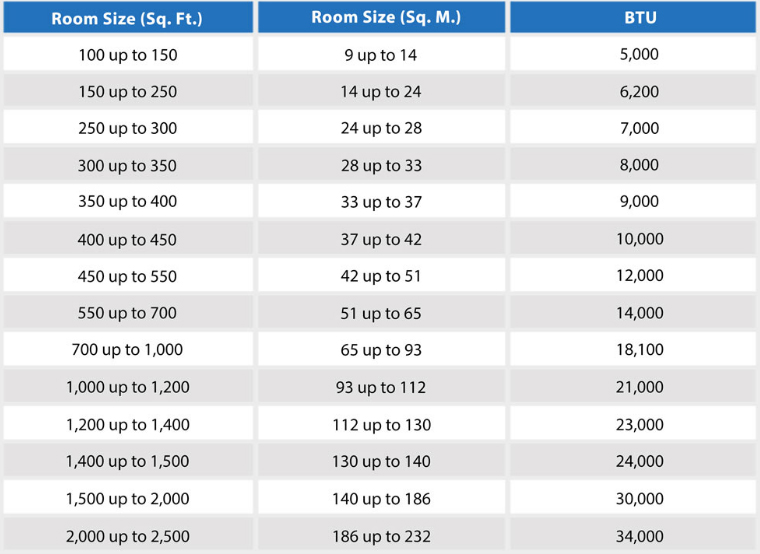
To determine the required power of an air conditioning unit, you need to perform a load calculation. This will give you a reading of 'BTUs' (British Thermal Units), which is the strength of the air conditioner. This takes into account several factors, including the area size, the number of people who are usually in the property and the number of windows the property has as well as what the rooms are used for. The formulas required to do this are quite complex since you will need to know the size of the property, the size of the windows, which direction the windows face, and the power and type of any appliances and lighting in the room.
You can find free HVAC Thermal Load Calculator tools online that will help you to perform these calculations. It is always a good idea to have your air conditioning contractor do the calculation for you, and if you have any concerns about the results that they come up with, sanity check them yourself later.
The Different Types of Units Available
There are several different kinds of air conditioner available, including central air conditioners and heat pumps which are designed to heat or cool the entire property, as well as ductless mini air conditioners, room air conditioners, and evaporative coolers. These all work slightly differently, and choosing the right type is as important as choosing the right size.
Room air conditioners can be mounted onto windows and are handy if your property is older and it would be hard to install a central air conditioner, or if you just want to cool one particular room. Ductless mini air conditioners are an excellent choice for very small areas as well. Evaporative coolers release moisture into the room as they work, which makes them a good choice for dry climates and for people who have certain respiratory conditions. These coolers are less effective in environments that are already humid, however, so it is prudent to seek advice from a specialist contractor before you spend a lot of money on a cooling system.
Subscribe to:
Posts (Atom)